
In 2025, average US roommate rents hit record highs in many major US metro areas, outstripping roommates' budgets. Roommate rental supply is being bolstered by so called 'live-in landlords' - those who rent out rooms in their own homes - and 2026 will likely see further rises, reports roommate site SpareRoom.
Years later, US renters are still shouldering the burden of intense market pressure caused by Covid-19. At the height of the pandemic, people stayed put, demand dropped off a cliff and rents fell. But, around mid 2021, the floodgates opened and people started moving all at once. Those record levels of demand forced rents sky high.
Demand has now returned to the levels seen before the pandemic, and what renters now need most - for rents to drop to affordable levels - hasn't happened. In fact, room rents hit record highs in 13 of the top 30 most popular metro areas among roommates in 2025, as shown in the table below.
Average monthly roommate rents in 2025
| Metropolitan area | Q4 2025 | Q3 2025 | Q2 2025 | Q1 2025 |
|---|---|---|---|---|
| Atlanta, GA | $953 | $934 | $946 | $951 |
| Austin, TX | $895 | $920 | $891 | $868 |
| Baltimore, MD | $916 | $942 | $968 | $892 |
| Boston, MA, NH | $1,257 | $1,267 | $1,354 | $1,338 |
| Charlotte, NC, SC | $883 | $907 | $869 | $876 |
| Chicago, IL, IN, WI | $987 | $973 | $992 | $977 |
| Dallas, TX | $875 | $890 | $919 | $905 |
| Denver, CO | $1,020 | $1,051 | $1,039 | $1,038 |
| Fort Lauderdale, FL | $1,163 | $1,162 | $1,166 | $1,141 |
| Fort Worth, TX | $829 | $837 | $842 | $844 |
| Houston, TX | $841 | $862 | $890 | $872 |
| Las Vegas, NV | $873 | $879 | $872 | $875 |
| Los Angeles, CA | $1,354 | $1,352 | $1,338 | $1,334 |
| Miami, FL | $1,288 | $1,318 | $1,364 | $1,385 |
| New York, NJ, NY | $1,484 | $1,476 | $1,530 | $1,514 |
| Orlando, FL | $916 | $914 | $901 | $931 |
| Philadelphia, MD, NJ, PA | $899 | $885 | $881 | $862 |
| Phoenix, AZ | $901 | $933 | $936 | $935 |
| Portland, OR, WA | $919 | $925 | $905 | $896 |
| Riverside, CA | $1,024 | $1,015 | $1,019 | $1,007 |
| Sacramento, CA | $1,032 | $1,002 | $963 | $970 |
| San Antonio, TX | $721 | $722 | $744 | $752 |
| San Bernardino, CA | $978 | $996 | $958 | $1,004 |
| San Diego, CA | $1,311 | $1,316 | $1,301 | $1,299 |
| San Francisco Bay Area, CA | $1,338 | $1,320 | $1,307 | $1,298 |
| Seattle, WA | $1,069 | $1,062 | $1,045 | $1,032 |
| Tampa, FL | $973 | $952 | $976 | $963 |
| Virginia Beach, NC, VA | $924 | $917 | $917 | $875 |
| Washington D.C., DC, MD, VA, WV | $1,129 | $1,142 | $1,123 | $1,144 |
| West Palm Beach, FL | $1,220 | $1,224 | $1,189 | $1,188 |
Source: SpareRoom quarterly rental index (highlighted cells denote the highest figure on record)
Five-year view
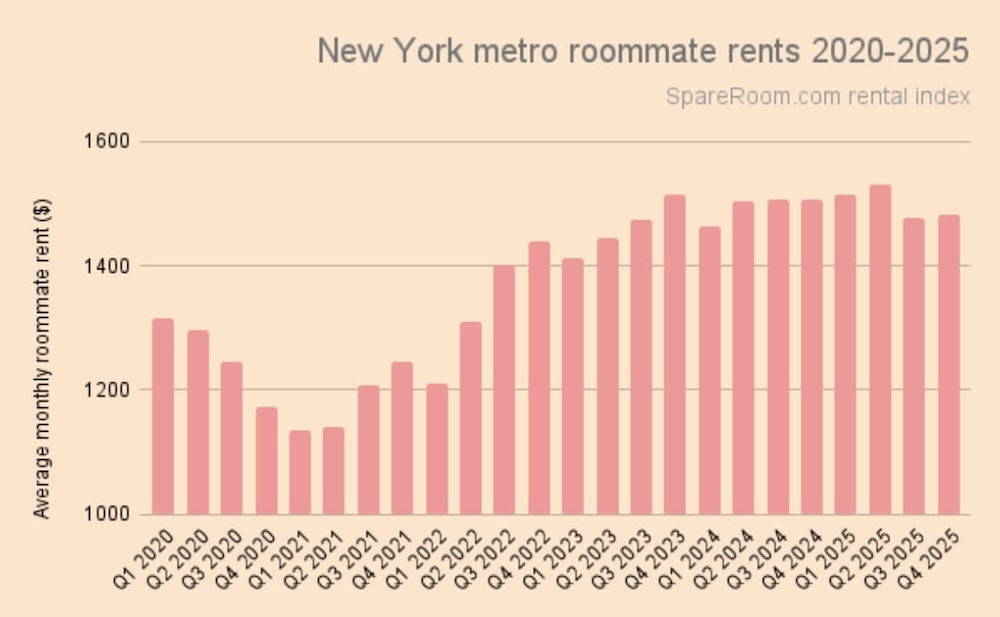
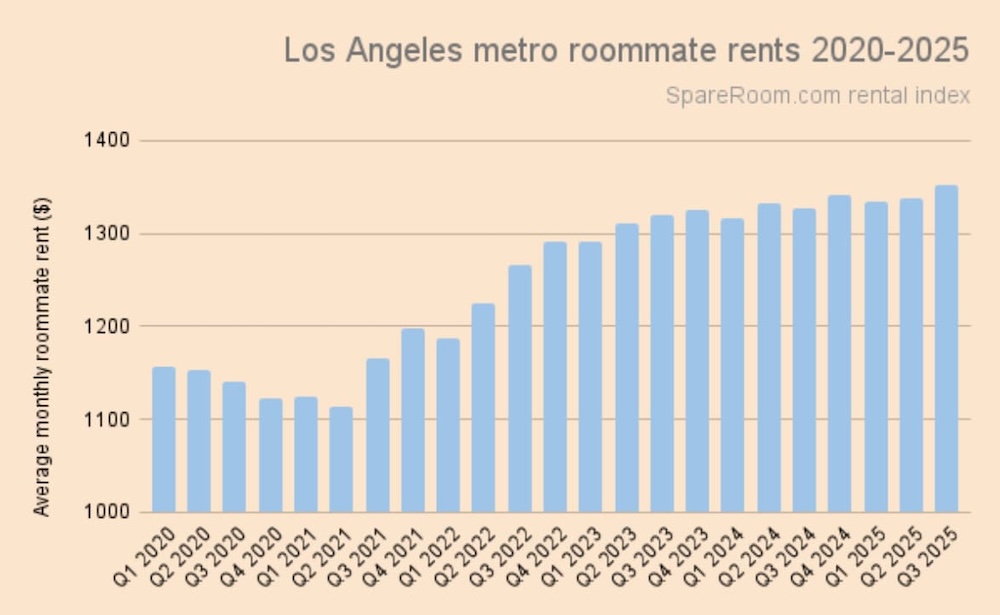
The two charts below show the dramatic impact of the pandemic on rent rises in New York and Los Angeles metropolitan areas, and they show a markedly similar pattern - sharp rises followed by a period of stabilisation, but no sustained decreases in rents.
Renter affordability
Sharing has always been the cheapest way to rent and yet average rents are outstripping budgets. SpareRoom tracks roommates' budgets, as well as asking prices for available rooms to rent. A Q2 2025 comparison of the two found the biggest affordability gap to be in Miami, where renters must pay $321 per month, or $3,852 per year, more than their budgets allow (source).
The reality for too many roommates is they're now spending upwards of 40% or 50% of their income on rent. The result? Life plans are delayed and the risk of debt is amplified.
Living with roommates has always been the cheapest way to rent, and yet US workers earning the national median wage of $49,500/year are now priced out of shared living in six of the 22 most popular metro areas (Q3 2025 data). Based on the '30% rule' - the maximum recommended proportion of income spent on housing costs - it also found New York to be the metro area least able to affordably house its lower-paid workers. With the highest average room rent, people must earn at least $59,040/year to ensure they don't exceed the threshold (source).
Rental supply
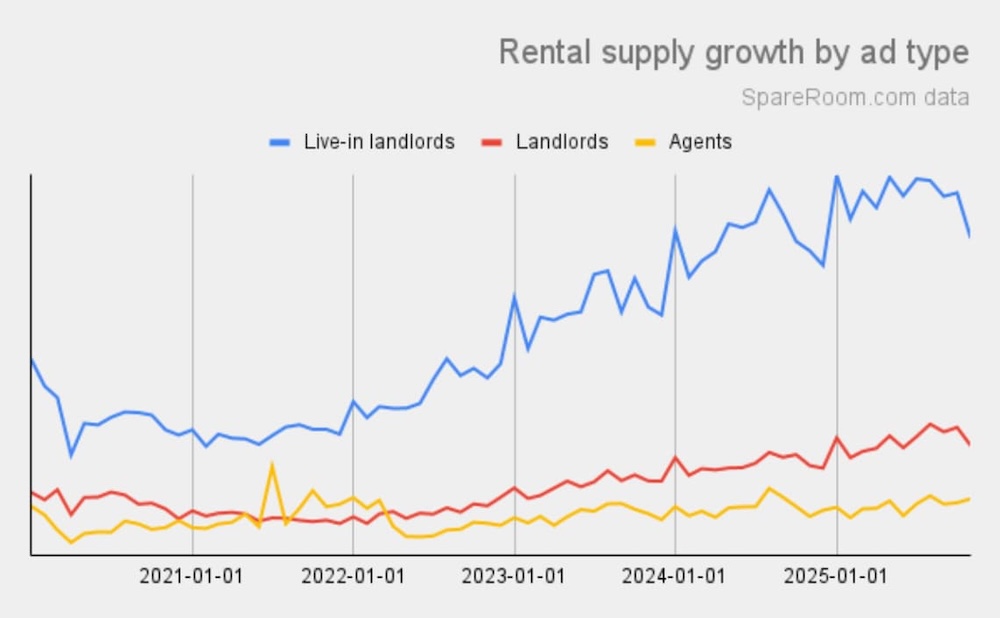
On the upside, roommate rental supply is still in growth but it's being largely boosted by existing households rather than landlords and agents. 'Live-in landlords' - homeowners and renters who rent out rooms in their own homes - make up 39% of supply in the roommate market, according to December 2025 data from SpareRoom.
Over the past five years, ads posted by these users have grown at a faster rate than ads from landlords who don't live in the property and agents, as shown in the graph below. Comparing all ads placed in 2020 and 2025, those placed by live-in landlords have more than doubled (+133%) while those placed by landlords have increased by 94% and by agents 56%.
Matt Hutchinson, director of roommate site SpareRoom, comments: “The data shows, in no uncertain terms, that the rental market still hasn't recovered from the chaos of intense demand from mid 2021. We have to get creative to make life easier for people struggling to manage the day-to-day cost of living.
“Live-in landlords inject desperately-needed supply into the US rental market and they charge lower-than-average rents. Taking sensible steps to remove existing barriers to homesharing - as well as co-living or single-room occupancy - would be a vital shot in the arm for the rental market, increasing the supply of affordable options while offering an income boost to those taking in roommates.
“People share their homes for all sorts of reasons and, while money is usually the leading motivation, many soon discover the added practical and social benefits of companionship and security in the home.”