
SpareRoom publishes its quarterly rental index for Q1 2026, which uniquely tracks roommate rents in shared households in 27 major US metros at the sharp end of America's housing affordability crisis.
- In the first quarter of 2026, roommates saw monthly rents hit record highs in the San Francisco Bay Area ($1,353), San Diego ($1,324), San Bernardino ($1,020), Seattle ($1,092) and Chicago ($1,037).
- Year-over-year, roommate rents are rising fastest in Chicago (8.1%), Philadelphia (5.6%) and Seattle (5.5%), while Boston (-4.5%), San Antonio (-4.2%) and Phoenix (-3.4%) have seen the biggest falls.
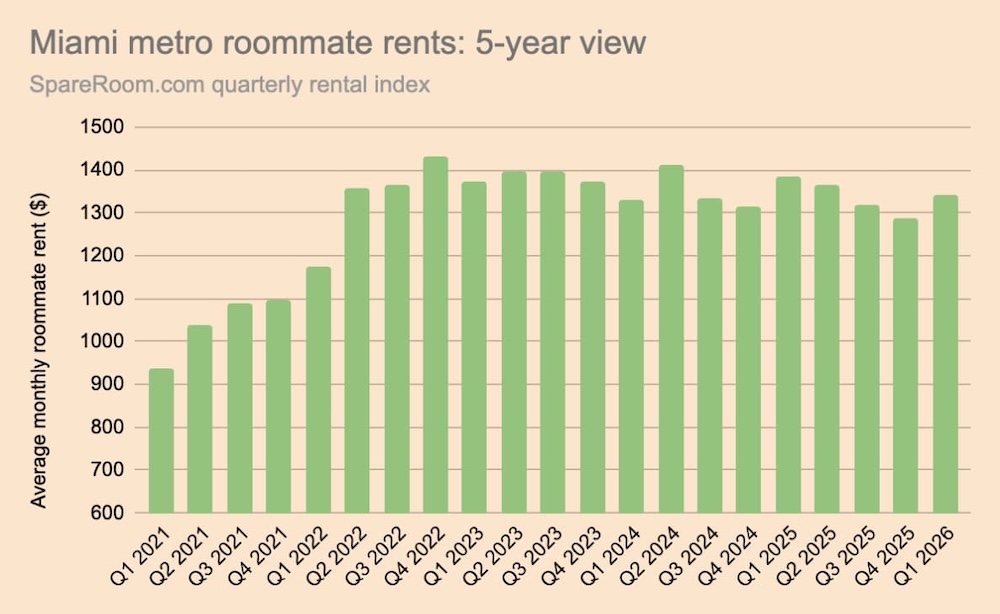
- More stable rental markets include Miami - rents here last reached a record high of $1,432 at the end of 2022 and fell 0.5% in the year to Q1 2026.
Sharing is the most affordable way to rent and, when the cost of living is sky-high and more people are priced out of renting solo, roommate rental supply is put under huge pressure. This explains why, in Q1 2026, roommate rents hit record highs in five major US metros, according to the latest data from roommate site SpareRoom.
As the West Coast supply-demand imbalance persists, rents in five major Californian metros have hit record highs in the past six months alone. Record-highs were reached in the San Francisco Bay Area ($1,353), San Diego ($1,324) and San Bernardino ($1,020). And in the previous quarter - Q4 2025 - rents hit record highs in Los Angeles ($1,354) and Sacramento ($1,032). But it's the Bay Area's rents that are out-pacing its CA neighbors, up 4.4% year over year.
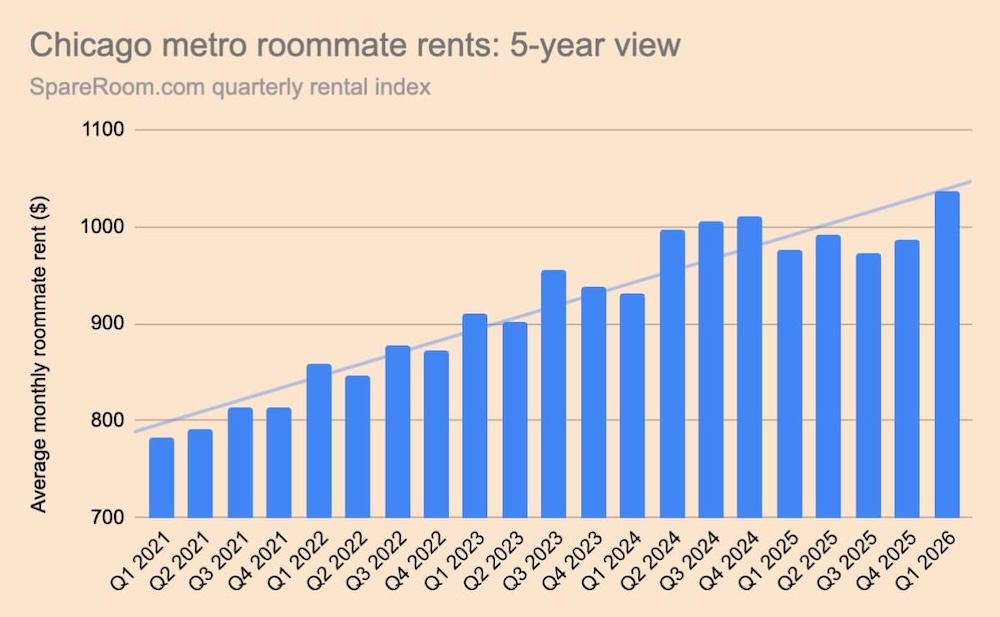
Chicago tops the Q1 rankings as the metro with the highest year-over-year average rent increase - up 8.1% to an all-time high of $1,037 per month. An extremely tight market, Chicago has one of the worst supply-demand imbalances and roommate demand is up by almost a third (+31%) on the previous year. This has put rents firmly on an upward trajectory, as shown in the chart below. There's also a sizable gap between roommates' average budgets - which are on average $880/month - and the average asking rent in Chicago, meaning roommates must 'find' an additional $1,884 a year to afford rent in the city.
It's a different picture in other metros, such as Miami where rents have been stabilizing, as shown in the chart below. Roommate rents here last hit a record high in Q4 2022 and, in the year to Q1 2026, roommates in Miami saw a marginal 0.5% rent decrease. However, roommate demand is up 11% on the previous year, making significant rent falls in the near future very unlikely. The supply-demand imbalance is keeping rents inflated in all major US metros, to varying degrees.
The table below shows average rents in the 27 metropolitan areas most popular among US roommates, in order of their year-over-year rent change. Record-high rents have been marked:
| Metro area | Average monthly roommate rent Q1 2026 | Average monthly roommate rent Q1 2025 | Year-over-year % change | |
|---|---|---|---|---|
| 1 | Chicago, IL,IN,WI | $1,037* | $959 | 8.1 |
| 2 | Philadelphia, MD,NJ,PA | $905 | $857 | 5.6 |
| 3 | Seattle, WA | $1,092* | $1,035 | 5.5 |
| 4 | New York, NJ,NY | $1,511 | $1,446 | 4.5 |
| 5 | San Francisco Bay Area, CA | $1,353* | $1,296 | 4.4 |
| 6 | Charlotte, NC,SC | $905 | $869 | 4.1 |
| 7 | Sacramento, CA | $1000 | $972 | 2.9 |
| 8 | Atlanta, GA | $963 | $937 | 2.8 |
| 9 | San Diego, CA | $1,324* | $1,294 | 2.3 |
| 10 | San Bernardino, CA | $1,020* | $1,001 | 1.9 |
| 11 | Riverside, CA | $1,026 | $1,008 | 1.8 |
| 12 | Tampa, FL | $976 | $962 | 1.5 |
| 13 | Baltimore, MD | $924 | $911 | 1.4 |
| 14 | Los Angeles, CA | $1,339 | $1,321 | 1.4 |
| 15 | Austin, TX | $884 | $875 | 1.0 |
| 16 | Las Vegas, NV | $873 | $871 | 0.2 |
| 17 | Fort Lauderdale, FL | $1,153 | $1,151 | 0.2 |
| 18 | Dallas, TX | $893 | $895 | -0.2 |
| 19 | Washington D.C., DC,MD,VA,WV | $1,122 | $1,127 | -0.4 |
| 20 | Miami, FL | $1,341 | $1,347 | -0.5 |
| 21 | Fort Worth, TX | $830 | $847 | -2.0 |
| 22 | Orlando, FL | $912 | $932 | -2.2 |
| 23 | Houston, TX | $809 | $830 | -2.5 |
| 24 | Denver, CO | $1,017 | $1,046 | -2.8 |
| 25 | Phoenix, AZ | $901 | $933 | -3.4 |
| 26 | San Antonio, TX | $736 | $768 | -4.2 |
| 27 | Boston, MA,NH | $1,273 | $1,333 | -4.5 |
Matt Hutchinson, director of roommate site SpareRoom, comments: “Sharing as a roommate is the most affordable way to rent, and yet roommates are far from immune to market pressures. Persistent increases, fueled by low supply relative to high demand for the cheapest accommodation, are squeezing budgets to the point where even the dynamics of shared households are now changing. It's no longer just young professionals who are sharing homes. Roommates under 35 are in decline, while older roommate cohorts are rising as people are sharing for longer and the youngest renters are priced out of the market altogether.
“Rents in some metros are more stable than others, and some are seeing year-over-year decreases. While that might sound largely positive, the supply-demand imbalance endures and that is sure to keep rents high. Unlike gas prices, which soar when oil prices rise and dip when they fall, rents tend to only go in one direction: up. Yes, they may flatline and, occasionally, dip slightly, but it's incredibly rare for rents to fall in any meaningful way. Affordability cannot improve until supply more closely meets demand.”