
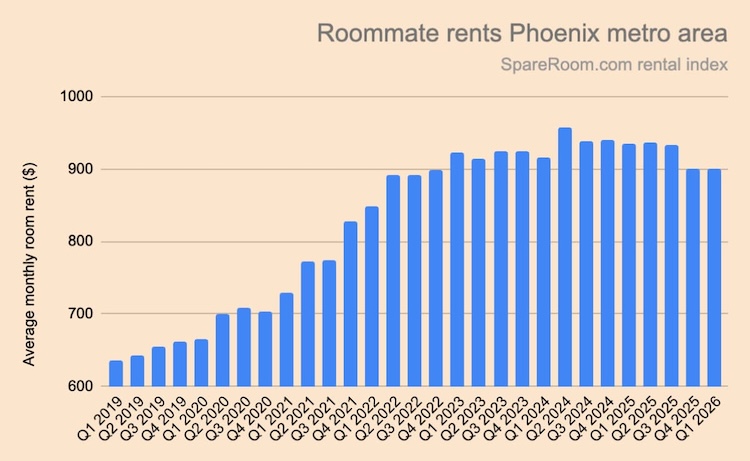
- Roommate rents in the Phoenix metropolitan area are falling 3.6% year over year.
- The average room rent is now $901 per month, well below the record high of $957 per month in Q2 2024.
- But even those living with roommates have struggled with housing costs; rents in Phoenix have risen 23% in five years.
- And it's changing the dynamics of shared rentals: priced-out young renters are now in decline as older renter cohorts are rising.
Rents are falling in Phoenix, by 3.6% year over year, according to the latest Q1 2026 rental index data from roommate site SpareRoom, which uniquely tracks roommate rents in shared households at the sharp end of America's housing affordability crisis.
It's some relief for those who have weathered years of post-pandemic rent increases. A record was set in Q2 2024 when roommate rents hit $957 per month in the metro area. Almost two years on, the average rent is now significantly lower, at $901 per month, where it has held steady for the past six months.
Toll of high rents on shared households
Rents grossly inflated by post-pandemic demand have changed the demographic of those who live in shared rentals in Phoenix. Over the past five years, the share of younger roommates under 35 - who are most typically associated with living in shared apartments - has declined as the proportion of older roommates has increased.
As shown in the table below, roommates aged 18-24 years old made up almost a third (32%) of Phoenix's roommate market in 2020, but five years later this had dropped to a quarter, as more young renters were priced out of the market altogether.
And, although they represent little more than a tenth of the market, roommates aged 55-64 years have seen the highest growth (+51%) of any age group in the past five years, while the share of retirement-age roommates (aged 65+) has increased by more than a quarter (+27%).
| Age group | Share of users in 2025 | Share of users in 2020 | 5-year change |
|---|---|---|---|
| 18-24 | 25.2% | 32.3% | -22% |
| 25-34 | 27.1% | 30.6% | -12% |
| 35-44 | 16.9% | 15.5% | 9% |
| 45-54 | 13.8% | 9.6% | 44% |
| 55-64 | 11.0% | 7.3% | 51% |
| 65+ | 6.2% | 4.8% | 27% |
Matt Hutchinson, director of roommate site SpareRoom, comments: “Given what's happened to the cost of living in recent times, news of falling rents is always going to be welcome. But it threatens to cloud the bigger picture, which is that rents soared after the pandemic, and have never fully recovered. As a result, affordability has been stretched to breaking point. This has priced some young renters out of the market completely and it's keeping older cohorts in shared rentals for longer.
“Cities that focus efforts squarely on increasing housing supply - not just new developments, but making better use of vacant and underoccupied units - will vastly improve things for their renting population.”