
- Though no longer rising dramatically, rent in Boston is still inflated well above pre-pandemic levels; roommate interest in the city fell (-15%) in the year to 2025.
- But roommates are taking a growing interest in the suburbs and beyond: high-risers include Lowell MA (+110%), Manchester NH (+109%), Woburn MA (+61%), Salem MA (+54%), and Watertown MA (+50%).
- Sharing is the most affordable way to rent yet, after years of high rents, even roommates are migrating further away in a bid to reduce living costs.
Roommate living is spreading beyond Boston and into the suburbs according to an analysis of more than 16 million area searches on SpareRoom in 2025 compared to the previous year.
Roommate searches for Manchester NH - while not a typical commuter suburb and some 50 miles to the north of Boston - more than doubled (+109%) in one year, while searches for Lowell MA were up 110%. Suburbs closer to the city and seeing significant rises in roommate interest also include Woburn MA (+61%), Salem MA (+54%), and Watertown MA (+50%).
By contrast, roommate searches for Boston MA decreased by 15% in the same period.
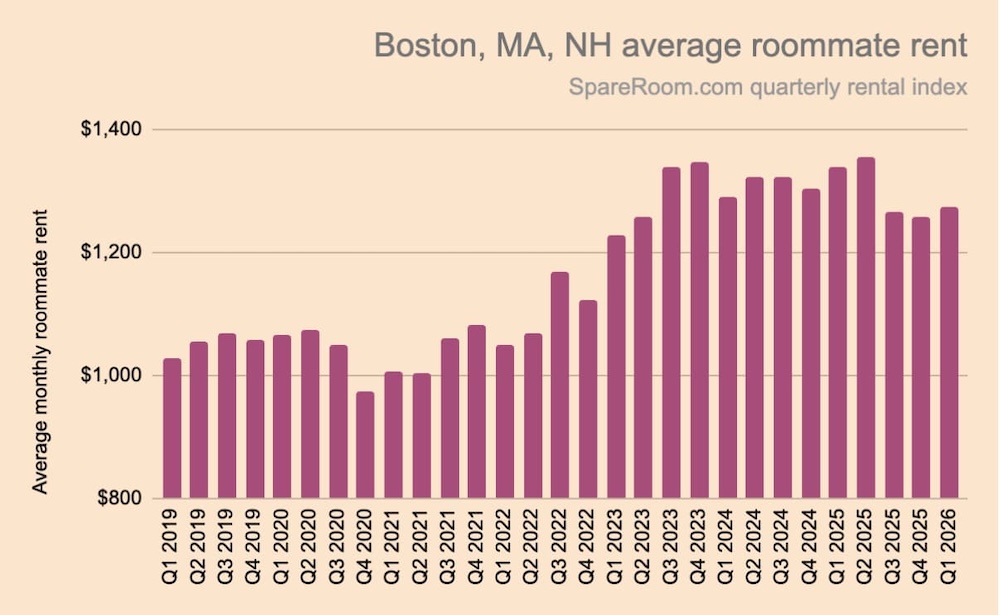
Data from SpareRoom's quarterly rental index (Q1 2026), which uniquely tracks roommate rent in shared households, puts the average monthly rent in Boston at $1,273 and decreasing 4.5% year over year. Rent hit a record high of $1,354 per month in Q2 2025.
The average roommate rent climbed steeply through 2021 and 2022 and, although now showing signs of stabilizing, has seen no significant decreases, as shown in the chart below:
The rising popularity of the suburbs may correspond with the increasing numbers who find themselves sharing a home in their 40s, 50s and beyond, priced out of home ownership and renting solo.
A knock-on effect of years of sustained high rents is that the typical Boston roommate isn't necessarily a young professional or graduate anymore: the share of younger roommates has declined as the proportion of older roommates has increased.
While the market is still dominated by 18-24 year olds - whose share of the roommate market has risen by 32% in five years likely due to pressure from students looking for off-campus accommodation - it's 55-64 year olds that have seen the biggest increase of any age group. While this group represents just 5% of the roommate market, this cohort has risen by 78% in five years.
As shown in the table below, the share of adults aged 45+ in the roommate market has increased by half in five years as the share of under 45s has dropped by 5%:
| Age group | % of users in 2025 | % of users in 2020 | 5-year change |
|---|---|---|---|
| 18-44 | 85.6% | 90.4% | -5% |
| 45+ | 14.4% | 9.6% | 50% |
Matt Hutchinson, director of roommate site SpareRoom, comments: “Sharing is the most affordable way to rent in Boston - roommate rents can be less than half those for a typical studio - so it speaks volumes when even roommates are deserting the city. It tells us that affordable housing in urban neighborhoods is becoming increasingly endangered, and shared living is increasingly becoming a suburban reality, as renters of all ages seek lower-cost alternatives to living alone.”