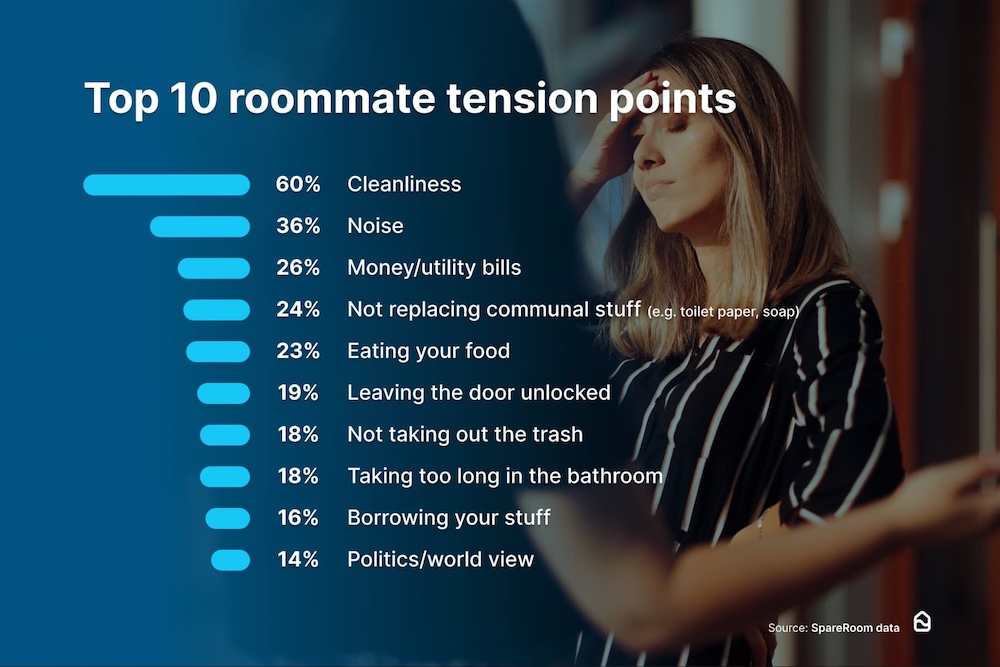
When 1,257 US roommates were asked what's most likely to cause disputes in their households, what do you think came top? Politics, food going missing, spending too long in the bathroom?
In fact, it's cleanliness that is the biggest cause of tension in shared rentals, according to the survey by roommate site SpareRoom.
And politics or world view is, in fact, less often a cause of household arguments than not taking out the trash or failing to buy communal items like toilet paper and cleaning supplies.
Fortunately, disagreements in shared rentals aren't all that common - but they do happen: 8% of roommates said they left their previous rental due to a roommate dispute.
And close to a fifth (19%) of roommates live with at least four other people which increases the likelihood of falling out.
The dynamics of roommates in shared households can vary: 50% consider the people they rent with to be their friends; 37% get along with their roommates but don't count them as friends; and 13% say they're not friends with their roommates.
The table below shows how people answered the survey question on roommate tension points:
| Q. What's most likely to cause tension between you and your roommate(s)? Select all that apply | Responses of US roommates | |
|---|---|---|
| 1 | Cleanliness | 60% |
| 2 | Noise | 36% |
| 3 | Money/utility bills | 26% |
| 4 | Not replacing communal stuff (e.g. toilet paper, soap) | 24% |
| 5 | Eating your food | 23% |
| 6 | Leaving the door unlocked | 19% |
| 7 | Not taking out the trash | 18% |
| 8 | Taking too long in the bathroom | 18% |
| 9 | Borrowing your stuff | 16% |
| 10 | Politics/world view | 14% |
| 11 | Putting the heating/AC on all the time | 13% |
| 12 | Being anti-social | 11% |
| 13 | Their partner | 8% |
| 14 | Calling unnecessary 'house meetings' | 7% |
| 15 | Taking over the TV | 6% |
| 16 | Forgetting their keys | 6% |
Matt Hutchinson, director of roommate site SpareRoom, comments: “Roommates have spoken and a harmonious household is a clean one. If you want your roommates to love you - or at least not give them good reason to be grumpy - then clean up after yourself, keep the noise down after hours, pay your bills on time, and remember that 'what's mine is yours' doesn't cut it with most roommates.
“Harmonious shared households rely on compromise, communication, kindness and respect. There's no such thing as the perfect roommate, just the perfect roommate for you. The best thing you can do is properly communicate your expectations before you live together, to make sure you're all on the same page and that your values and expectations align. For example, some roommates hope to be good friends and socialize with the people they live with, others are happy just to be friendly. Are your routines compatible so you don't disrupt each other's sleep? Do you all like your home pristine, or are you relaxed about a bit of mess?
“Head off arguments by discussing how you want the household to operate and write up a roommate agreement, which can be referred to if needed. It could cover how cleaning and other chores are to be divided up, how you'll handle any disagreements, and house rules on other potentially contentious issues like overnight guests and working from home.”