
- The proportion of 55-64 year olds looking for roommates and rooms in shared rentals in the Atlanta metro area has risen 76% in five years, the biggest increase of any age group.
- Unaffordable rents are changing household dynamics, with more young people excluded from the rental market altogether and older renters increasingly priced out of living solo.
- The average roommate rent in Atlanta is now outpacing roommate budgets by $1,836/year.
- The price of living solo in a one-bedroom apartment is $7,632/year higher than sharing as a roommate1.
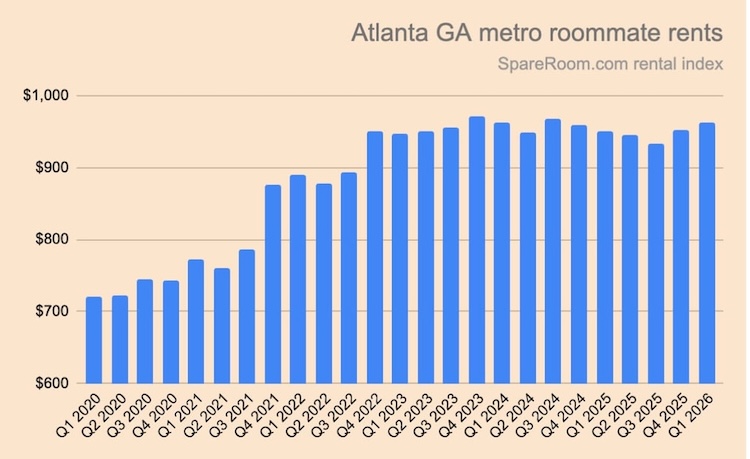
The average roommate rent in the Atlanta metro area is rising 2.8% year over year and is now $963/month - exceeding the average roommate's budget for housing by $153/month. That's according to roommate site SpareRoom's quarterly rental index for Q1 2026, which uniquely tracks roommate rents in shared households at the sharp end of America's housing affordability crisis.
Affordability gap
As the chart below shows, rents in Atlanta rose sharply from mid 2021, after the pandemic. For the past three years, rents have been stabilizing, but there have been no significant or sustained decreases taking rents back down to affordable levels.
Consequently, there is now a sizable gap between what roommates can afford to pay in rent - $810/month on average - and the current average rent ($963/month), leaving an annual shortfall of more than $1.8K.
Roommates in Atlanta are getting older
One effect of years of inflated rents is that the proportion of older roommates has increased. Over the past five years, the share of younger roommates under 35 - the group most typically associated with living in shared apartments - has declined as the proportion of older roommates has increased.
Roommates aged 18-24 years old made up a third of the roommate market in 2020, but five years later this had dropped to a quarter, as more young renters were priced out of the market.
Although they make up less than 10% of the market, roommates aged 55-64 years old have seen the highest growth (+76%) of any age group in the past five years. For increasing numbers of older renters, the price of living solo in a one-bedroom apartment is prohibitive: it's $636/month or $7,632/year higher than sharing as a roommate1.
| Age group | Share of users in 2025 | Share of users in 2020 | 5-year change |
|---|---|---|---|
| 18-24 | 25.2% | 33.2% | -24% |
| 25-34 | 29.2% | 34.8% | -16% |
| 35-44 | 19% | 13.8% | 38% |
| 45-54 | 13% | 8.6% | 52% |
| 55-64 | 8.7% | 4.9% | 76% |
| 65+ | 4.9% | 4.8% | 2% |
Matt Hutchinson, director of roommate site SpareRoom, comments: “Roommates are hit by every spike, but rarely see any relief when demand drops. Unlike gas prices, which rise and fall with oil prices, rents rarely come back down. Broadly, this has been the picture in most major US metros. Intense demand in the market post-pandemic forced up rents. They're still high today because although demand isn't where it was, there is still not enough supply to go around.
“Stubbornly high rents are changing the dynamics of shared households. Older renters who might once have wanted to live alone are sharing with roommates, and the youngest would-be renters aren't flying the nest because they just can't afford the rent.”